

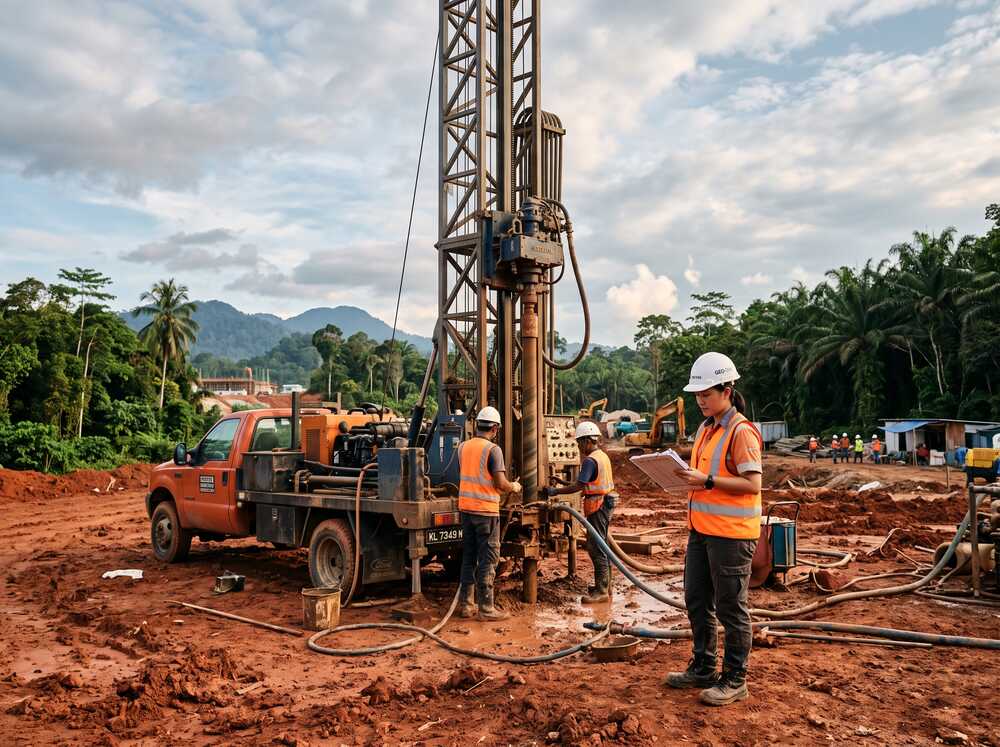
- Soil investigation cost in Malaysia varies widely — from approximately RM5,000 for a small residential plot to RM150,000+ for large commercial or infrastructure projects.
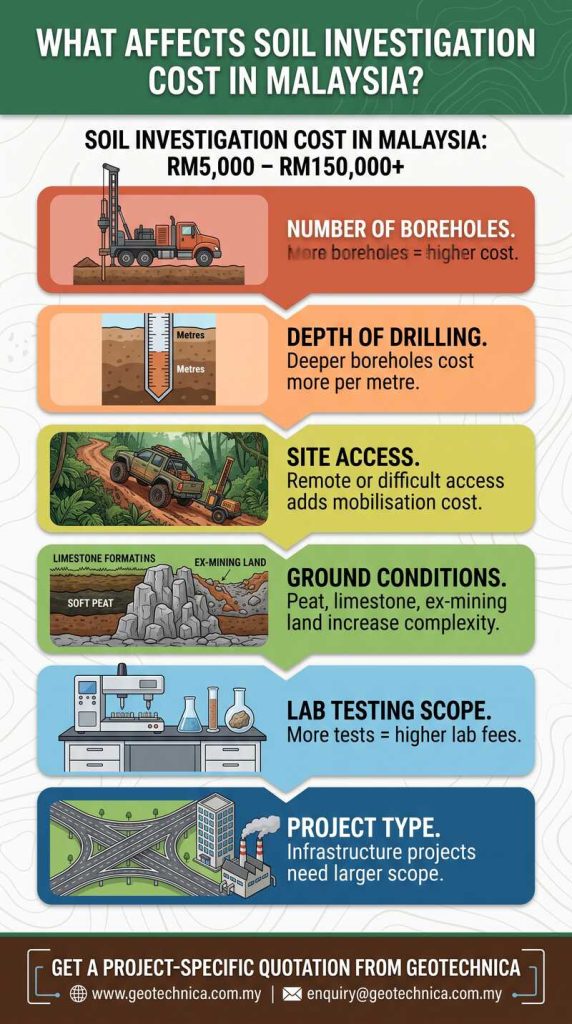
- Key cost drivers include the number and depth of boreholes, site accessibility, ground conditions (peat, limestone, soft clay), laboratory testing requirements, and project complexity.
- Skipping or under-scoping soil investigation is one of the most common reasons construction budgets overrun in Malaysia.
- A proper soil investigation report helps engineers design safe foundations, avoid delays and meet regulatory requirements under Malaysian standards.
- Engaging a qualified geotechnical consultant early in the planning phase typically saves far more than the investigation costs.
What Is Soil Investigation?
Soil investigation — also referred to as site investigation or geotechnical investigation — is the process of examining subsurface ground conditions before construction begins. It involves drilling boreholes, collecting soil samples, conducting field and laboratory tests, and producing a geotechnical report that informs foundation design, earthwork planning, and risk assessment.
In Malaysia, soil investigation is a critical step for virtually every construction project, from residential housing to highways, solar farms and data centres. The data collected determines what type of foundation system is suitable, how deep piling needs to go, and whether the ground poses any risks such as settlement, slope instability or underground voids.
Without it, engineers are essentially designing foundations blindly — and the cost of getting it wrong almost always exceeds the cost of the investigation itself.
Why Soil Investigation Is Needed Before Construction
Prevent Foundation Failure
Foundation problems are among the most expensive construction defects to repair. Differential settlement, bearing capacity failure and slope collapse all trace back to inadequate understanding of ground conditions. A properly scoped soil investigation identifies these risks before a single pile is driven.
Avoid Cost Overruns From Unknown Ground Conditions
Unexpected ground conditions — hitting rock where none was expected, encountering soft clay at depth, or discovering an old mining void — can halt a project and add hundreds of thousands of ringgit to the budget. Soil investigation provides the ground data contractors need to price earthworks and foundation works accurately.
Meet Regulatory & Approval Requirements
In Malaysia, local authorities and agencies such as Jabatan Kerja Raya (JKR), Jabatan Mineral dan Geosains (JMG) and municipal councils require soil investigation reports as part of development plan submissions. For slopes steeper than 15°, a geotechnical report is typically mandatory. Submitting without one risks rejection and delays.
Who Needs Soil Investigation in Malaysia?
Soil investigation is not limited to mega-projects. The following stakeholders regularly require geotechnical data:
- Property developers — for residential, commercial and mixed-use developments to inform foundation design and cost estimation.
- Consulting engineers — to prepare geotechnical design recommendations and meet professional liability standards.
- Architects — to understand site constraints that affect building layout, especially on sloped or challenging terrain.
- Contractors & sub-contractors — to accurately price piling, earthworks and temporary works during tendering.
- Government agencies & statutory bodies — for infrastructure such as highways, dams, water treatment plants and public housing.
- Industrial & energy developers — for warehouses, factories, solar farms, wind farms and data centre foundations.
If you are building anything on or in the ground in Malaysia, soil investigation is not optional — it is a project risk management necessity.
How Does Soil Investigation Work?
Desktop Study & Site Reconnaissance
Before any drilling, a geotechnical consultant reviews existing geological maps, historical records, aerial imagery and any previous site investigation data for the area. A physical site walkover identifies visible ground features, access constraints, water bodies and potential hazards.
Borehole Drilling & Sampling
Boreholes are drilled to predetermined depths using rotary or percussion drilling rigs. During drilling, soil and rock samples are collected at regular intervals — typically every 1.5 m. The Standard Penetration Test (SPT) is conducted at each sampling interval to measure soil resistance, providing N-values that engineers use to assess bearing capacity.
In-Situ Testing
Depending on the project scope and ground conditions, additional field tests may be conducted:
- Field Vane Shear Test (FVST) — for measuring the undrained shear strength of soft clay.
- Cone Penetration Test (CPT) — for continuous soil profiling without sampling.
- Mackintosh Probe — a lightweight penetration test commonly used in Malaysia for preliminary assessment of soft ground.
- Electrical Resistivity Survey — a non-invasive geophysical method for mapping subsurface variations.
Laboratory Testing
Soil samples are sent to accredited laboratories for testing. Common laboratory tests include:
- Atterberg Limits (Liquid Limit & Plastic Limit)
- Particle Size Distribution / Sieve Analysis
- Moisture Content & Bulk Density
- Unconfined Compressive Strength (UCS) — for rock cores
- Consolidation Test — particularly important for soft clay and peat
- Triaxial Shear Test
- Chemical analysis (sulphate, chloride, organic content, pH)
Reporting & Recommendations
The final soil investigation report presents borehole logs, SPT profiles, laboratory results, soil stratification, groundwater levels and geotechnical recommendations for foundation design. This report becomes the basis for structural and geotechnical engineering decisions.
Factors That Affect Soil Investigation Cost in Malaysia
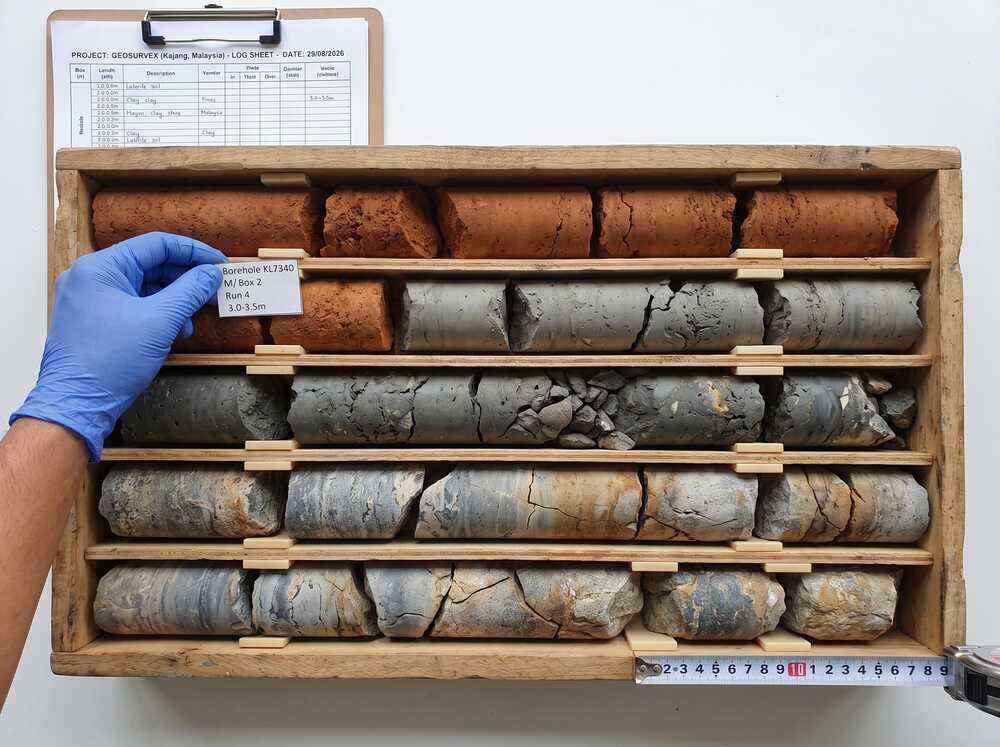
Soil investigation cost is not a fixed number — it depends on several project-specific variables. Understanding these factors helps project owners budget accurately and avoid under-scoping.
Number & Depth of Boreholes
This is the single largest cost driver. A small residential plot may need only 1–3 boreholes drilled to 15–20 m depth, while a large commercial development or highway alignment could require 20–50+ boreholes drilled to 30–60 m or deeper. Each additional borehole adds mobilisation time, drilling cost and laboratory testing fees.
Site Access & Location
Remote sites, hillside locations, swampy terrain or sites without proper access roads increase mobilisation cost significantly. In East Malaysia (Sabah & Sarawak), logistics costs are generally higher due to transportation challenges.
Type of Ground Conditions
Drilling through hard rock, boulders or limestone pinnacles takes longer and causes more wear on equipment. Conversely, very soft ground may require casing or mud stabilisation to prevent borehole collapse, adding time and cost.
Scope of Laboratory Testing
A basic SI package may include only SPT, moisture content and Atterberg limits. More complex projects require consolidation tests, triaxial tests, chemical analysis, permeability tests and rock core testing — each adding to the laboratory bill.
Project Type & Complexity
Infrastructure projects (highways, pipelines, dams) require more extensive investigation than a typical building plot. Projects on slopes, near waterways, or in areas with known geological hazards will also require additional scope.
Soil Investigation Cost Comparison by Project Type
The table below provides general cost guidance for soil investigation in Malaysia. These are indicative ranges based on typical industry practice — actual costs vary depending on the factors above. Always obtain project-specific quotations from a qualified geotechnical consultant.
| Project Type | Typical No. of Boreholes | Typical Depth | Estimated Cost Range (RM) |
|---|---|---|---|
| Single residential lot | 1–3 | 15–20 m | RM5,000 – RM20,000 |
| Terrace / link house development | 5–15 | 15–25 m | RM20,000 – RM60,000 |
| Commercial building / office tower | 5–20 | 20–40 m | RM30,000 – RM100,000 |
| Industrial / factory / warehouse | 5–15 | 15–30 m | RM25,000 – RM80,000 |
| Solar farm | 10–30+ | 10–20 m | RM30,000 – RM120,000 |
| Highway / road alignment | 20–50+ | 15–40 m | RM80,000 – RM300,000+ |
| Data centre | 5–20 | 20–40 m | RM40,000 – RM150,000 |
| Slope / hillside development | 5–15 | 15–30 m | RM30,000 – RM100,000 |
Note: Costs are indicative estimates based on typical Malaysian market conditions. Actual costs depend on site-specific factors, ground conditions and scope of work. Contact Geotechnica for a project-specific quotation.
Malaysia-Specific Ground Conditions That Influence Cost
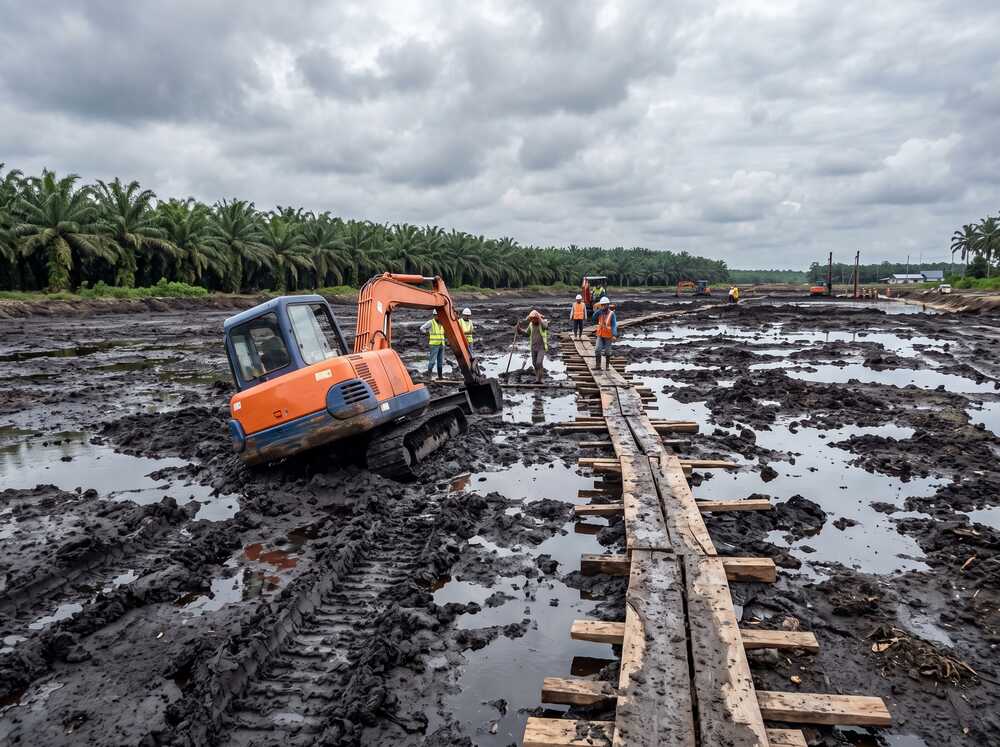
Malaysia’s diverse geology means that soil investigation scope — and therefore cost — varies significantly depending on where you are building.
Peat Soil
Found extensively in Sarawak, Johor and parts of Selangor, peat soil is highly compressible and poses serious settlement risks. Soil investigation in peat areas typically requires deeper boreholes, consolidation testing and sometimes specialised sampling techniques, increasing costs.
Soft Clay / Marine Clay
Common in coastal areas and river floodplains (Port Klang, Penang, Johor Bahru), soft clay requires careful assessment of bearing capacity and long-term settlement. Field vane shear tests and consolidation tests are typically required, adding to the testing budget.
Limestone & Karst
Found in parts of Perak (Ipoh), Selangor (Batu Caves area), Perlis and Sabah, limestone terrain can contain solution cavities, pinnacles and irregular rock surfaces. Soil investigation in karst areas is inherently more complex — boreholes may need to be deeper, closely spaced and supplemented with geophysical surveys such as electrical resistivity to map subsurface voids. This substantially increases cost.
Ex-Mining Land
Former tin mining areas in Perak, Selangor and Pahang contain unpredictable fill material, loose sand tailings, old shafts and variable ground conditions. Investigation needs to be more extensive to map the disturbed ground profile accurately.
Reclaimed / Fill Ground
Coastal reclamation projects (Penang, Melaka, Johor — Forest City) involve placed fill over marine clay. The investigation must assess both the fill quality and the underlying natural ground, often requiring deeper boreholes and more laboratory tests.
How to Procure Soil Investigation Services in Malaysia
Procuring soil investigation is not as simple as choosing the cheapest quotation. Here is a practical guide:
- Define your project requirements clearly — share site plans, proposed building layouts, loading information and any known ground conditions with the geotechnical consultant.
- Request a scope of work proposal — a qualified consultant will recommend the number of boreholes, depths and testing programme based on your project needs, not just offer a generic package.
- Check qualifications — ensure the contractor has registered Professional Geologists (P.Geol.) or Professional Engineers (P.E.) on their team, and that laboratory testing is conducted at accredited facilities.
- Compare scope, not just price — the cheapest quotation often means fewer boreholes, shallower depths or limited testing. This saves money upfront but can cost significantly more later if the data is insufficient for design.
- Confirm deliverables and timelines — ensure the proposal includes a full soil investigation report with borehole logs, SPT data, laboratory results and geotechnical recommendations.
What You Get: Deliverables From a Soil Investigation
A complete soil investigation report typically includes:
- Borehole logs — graphical records showing soil and rock layers, SPT N-values, sample descriptions and groundwater levels at each borehole location.
- SPT profiles — plots of blow counts vs depth showing soil resistance trends across the site.
- Laboratory test results — certificates and data sheets for all tests conducted.
- Soil stratigraphy — cross-sectional diagrams showing how soil layers vary across the site.
- Groundwater assessment — recorded water levels and observations on seepage or artesian conditions.
- Geotechnical recommendations — foundation type suggestions, allowable bearing capacity, estimated pile lengths and any special considerations.
- Site location plan & borehole layout — maps showing where boreholes were drilled relative to the proposed development.
Common Mistakes That Increase Soil Investigation Cost
Ironically, the most expensive mistakes are usually attempts to save money:
1. Reducing the number of boreholes to cut cost — Fewer boreholes mean less data. When unexpected ground conditions are discovered during construction, remedial works can cost 10–50x more than the additional boreholes would have.
2. Drilling too shallow — If boreholes do not reach competent ground, pile lengths may be underestimated. Re-mobilising a drilling rig after construction has started is far more expensive than drilling deeper initially.
3. Skipping laboratory testing — Relying solely on SPT data without confirmatory lab tests can lead to incorrect soil classification and inappropriate foundation design.
4. Using unqualified contractors — Budget SI contractors without proper geological supervision may produce unreliable borehole logs and test results. The cost of re-investigation erases any initial savings.
5. Starting SI too late — Rushing soil investigation to meet project deadlines leads to incomplete data and design assumptions that may not hold. Engaging a geotechnical consultant during the planning phase is always more cost-effective.
6. Not investigating the full site area — Concentrating boreholes in one zone while ignoring other parts of the site creates data gaps that surface during construction.
Practical Checklist Before Hiring a Soil Investigation Contractor
Use this checklist to ensure you are prepared:
Site plan or survey plan with proposed building footprint is available
Project brief is defined — building type, number of storeys, estimated loading
Any existing geological or geotechnical data for the area has been reviewed
Budget for soil investigation has been allocated (not as an afterthought)
At least 2–3 qualified geotechnical consultants have been shortlisted
Proposals are compared on scope of work, not just price
Contractor’s team includes a registered P.Geol. or P.E.
Laboratory testing will be conducted at an accredited facility
Report deliverables and timeline are clearly stated in the contract
Access to the site for drilling equipment has been confirmed
FAQ
1. How much does soil investigation cost in Malaysia?
Soil investigation cost in Malaysia typically ranges from RM5,000 for a small residential plot to RM150,000 or more for large commercial or infrastructure projects. The cost depends on the number of boreholes, drilling depth, ground conditions, laboratory testing scope and site accessibility. Always request a project-specific proposal rather than relying on generic estimates.
2. Is soil investigation mandatory in Malaysia?
Soil investigation is required by most local authorities as part of development plan submissions. For hillside and slope developments, geotechnical reports are mandatory under guidelines issued by JKR and state authorities. Even where not strictly mandated by law, professional engineering practice standards and insurers effectively make it a requirement for responsible construction.
3. Can soil investigation prevent construction delays?
Yes. One of the most common causes of construction delays in Malaysia is encountering unexpected ground conditions — soft clay, rock, voids or contaminated fill. A thorough soil investigation identifies these conditions before construction begins, allowing the design team to plan appropriate foundation solutions and the contractor to price the work accurately.
4. What is included in a soil investigation report?
A complete soil investigation report includes borehole logs, Standard Penetration Test (SPT) data, laboratory test results, soil stratigraphy, groundwater level records and geotechnical recommendations for foundation design. It may also include geophysical survey results, slope stability analysis and environmental assessments depending on the project scope.
5. Is the cheapest soil investigation quotation the best choice?
Not usually. The cheapest quotation often reflects a reduced scope — fewer boreholes, shallower depth or limited laboratory testing. Insufficient ground data can lead to design errors, construction delays and remedial costs that far exceed the savings. Compare proposals on scope of work, team qualifications and deliverables rather than price alone.
Why Choose Geotechnica?
Geotechnica Sdn Bhd is a Malaysian geotechnical engineering company with over 15 years of experience in soil investigation, geophysical surveys and geohazard assessment across Peninsular Malaysia, Sabah and Sarawak.
- Full-service geotechnical capability — from borehole drilling and in-situ testing to laboratory analysis and geotechnical reporting under one roof.
- Registered professionals — led by P.Geol. Gs. Hairil Azwan Razak, a geohazard specialist with hands-on experience across diverse Malaysian ground conditions including peat, soft clay, limestone, ex-mining land and reclaimed ground.
- Technology-integrated approach — Geotechnica combines traditional geotechnical methods with advanced geophysical techniques (electrical resistivity, MASW) and LiDAR mapping for more comprehensive ground assessment.
- Trusted by developers, consultants and government agencies — Geotechnica has delivered projects for residential developments, highways, industrial facilities, solar farms and slope remediation works across Malaysia.
- Transparent pricing — project-specific proposals based on actual site requirements, not generic packages.
Conclusion
Soil investigation cost in Malaysia is an investment in project certainty — not an expense to be minimised. The cost of a properly scoped investigation is always a fraction of what foundation failures, construction delays or regulatory rejections would cost.
Understanding the factors that drive soil investigation pricing — number of boreholes, depth, ground conditions, testing scope and site access — allows developers, engineers and contractors to budget realistically and make informed procurement decisions.
The most important decision is not how much to spend, but whether the scope of investigation is adequate for the ground conditions and the project requirements. Engaging a qualified geotechnical consultant like Geotechnica early in the planning phase is the most reliable way to avoid costly mistakes.
SOURCES / REFERENCES
- British Standard BS 5930:2015+A1:2020 — Code of Practice for Ground Investigations
- Malaysian Standard MS 1056 — Site Investigation (referenced by JKR)
- Jabatan Kerja Raya (JKR) — Guidelines for Slope Design and Geotechnical Investigation
- Jabatan Mineral dan Geosains Malaysia (JMG) — Geological Survey Data
- Institution of Engineers Malaysia (IEM) — Geotechnical Engineering Division guidance notes
- Eurocode 7 (EC7) — Geotechnical Design, adopted in Malaysia for certain project categories
This article has been technically reviewed by P.Geol. Gs. Hairil Azwan, Geohazard Specialist and Managing Director at Geotechnica Sdn. Bhd., with 15 years of professional experience in geology, geotechnical engineering and geospatial technology.
Next Review: 10 February 2027


