

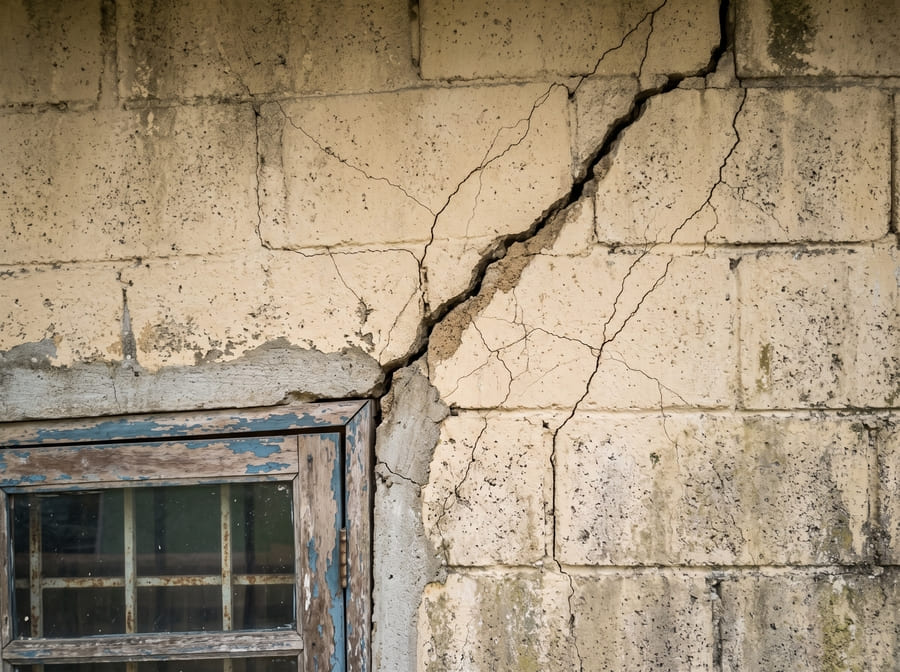
- Foundation settlement is the downward movement of a building’s foundation caused by compression, consolidation or displacement of the soil beneath it.
- Differential settlement — where different parts of a building settle by different amounts — is the primary cause of structural cracking and damage.
- In Malaysia, high-risk ground conditions include soft marine clay, peat soil, limestone karst, reclaimed land and ex-mining areas.
- Warning signs include diagonal wall cracks, sticking doors and windows, uneven floors, separation of walls from ceilings, and visible tilting.
- The most effective prevention is a thorough soil investigation followed by appropriate foundation design — not reacting after cracks appear.
What Is Building Foundation Settlement?
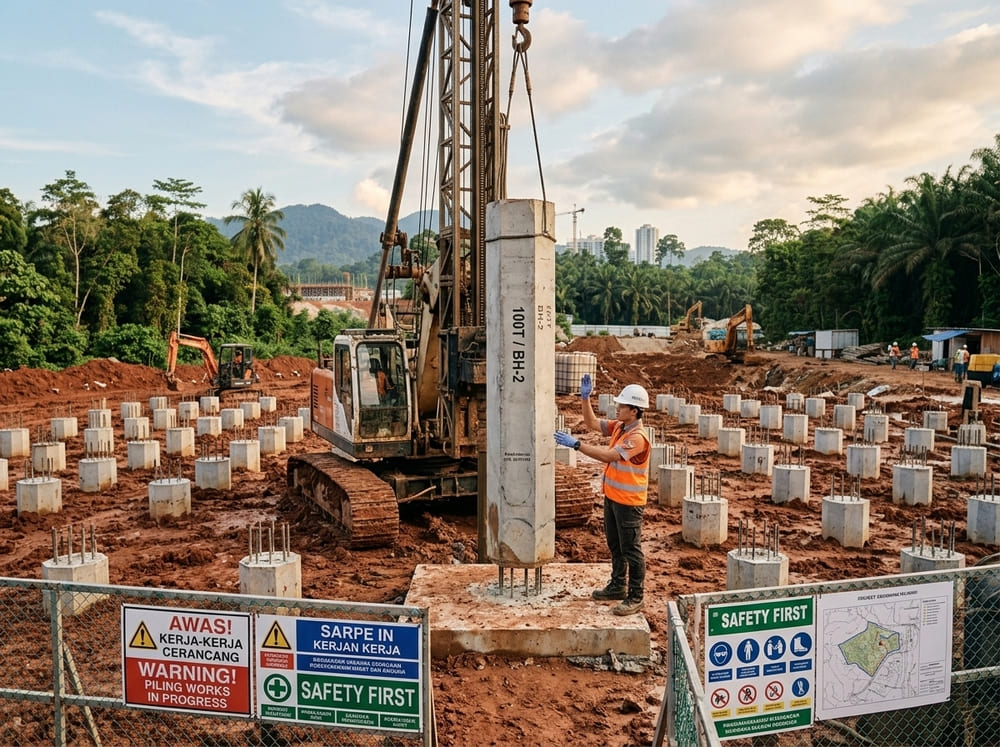
Building foundation settlement is the downward movement of a structure caused by changes in the soil beneath its foundations. All buildings settle to some degree after construction — a small amount of uniform settlement is normal and generally harmless.
The problem arises when settlement is excessive or, more critically, when it occurs unevenly across the building footprint. This uneven movement — called differential settlement — creates internal stresses in the structure that manifest as cracks in walls, misaligned doors and windows, tilting floors and, in severe cases, structural failure.
Foundation settlement is not just a cosmetic issue. It is a structural and safety concern that can affect building serviceability, reduce property value and — in extreme cases — render a building unsafe for occupation.
Types of Foundation Settlement
Uniform Settlement
The entire building settles by the same amount. While this can cause serviceability issues (utility connections, floor level differences with adjacent structures), it does not typically cause structural cracking. Uniform settlement is relatively rare in practice because ground conditions are seldom perfectly uniform.
Differential Settlement
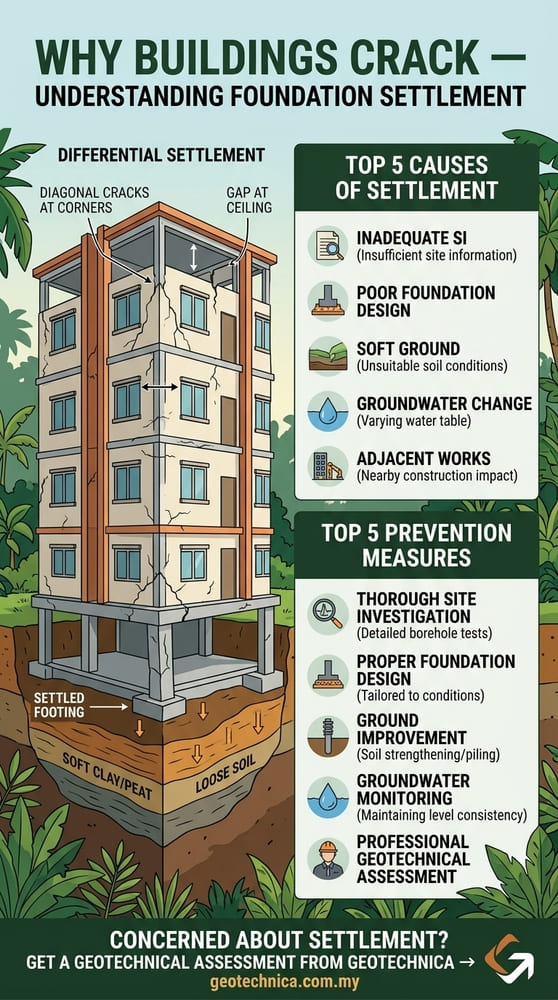
Different parts of the building settle by different amounts. This is the most damaging type because it introduces bending, shear and tensile forces into the structure that it was not designed to resist. Most visible cracking in buildings is caused by differential settlement.
Consolidation Settlement
A time-dependent process where water is slowly squeezed out of saturated fine-grained soils (clay, silt) under the weight of the building. Consolidation settlement can continue for months, years or even decades after construction — particularly in soft clay and peat. This is the dominant settlement mechanism in many Malaysian coastal and lowland sites.
Immediate (Elastic) Settlement
Occurs almost instantly when load is applied. This is typically small and largely complete by the time construction finishes. It is significant mainly in granular soils (sand, gravel) and stiff clay.
Why Does Foundation Settlement Occur?
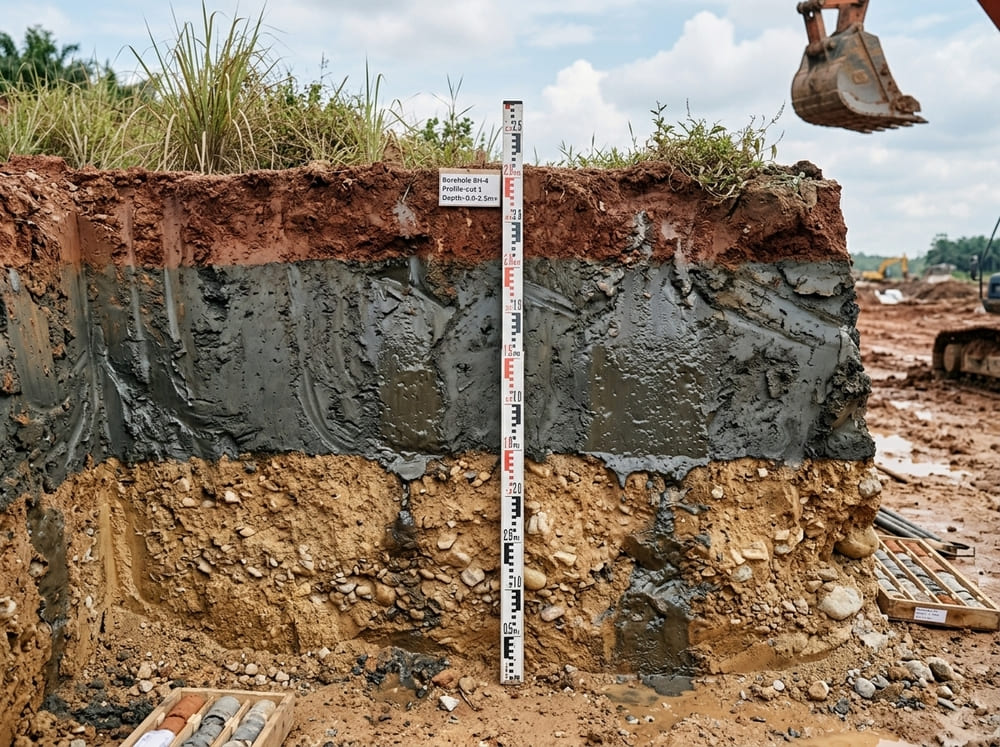
Inadequate Soil Investigation
The most common root cause of unexpected settlement in Malaysia. Without proper borehole testing and laboratory data, engineers may underestimate the compressibility of the soil, fail to detect soft layers, or design foundations that do not reach competent bearing strata.
Poor Foundation Design
Even with good soil data, incorrect interpretation or inappropriate foundation selection can lead to settlement. Common design errors include:
- Shallow foundations on compressible soil that should have been piled.
- Piles that are too short to reach competent ground.
- Inadequate consideration of negative skin friction in soft clay.
- Mixing foundation types (e.g., piled and unpiled) within the same building without accounting for differential movement.
Problematic Ground Conditions
Certain soil types are inherently prone to settlement:
- Soft clay / marine clay — highly compressible, undergoes long-term consolidation.
- Peat — extremely compressible, can settle by 20–40% of its original thickness.
- Loose fill — poorly compacted fill material settles under building loads.
- Collapsible soils — certain residual soils collapse when wetted.
Changes in Groundwater Level
Lowering the water table — through dewatering for adjacent construction, drought, or changes in drainage patterns — increases effective stress on the soil, triggering consolidation settlement. Conversely, rising water tables can soften certain soils.
Adjacent Construction Activity
Excavation, piling or dewatering on neighbouring sites can affect ground conditions beneath existing buildings. Vibrations from piling can densify loose sands (causing settlement) or disturb sensitive clays.
Overloading
Adding floors, heavy equipment or significant fill around a building increases the load on foundations beyond their original design capacity, potentially triggering settlement.
Who Is At Risk of Foundation Settlement?
- Property owners — residential and commercial buildings on soft or problematic ground.
- Developers — projects on reclaimed land, coastal sites, peat areas or ex-mining land.
- Industrial facility operators — warehouses and factories with heavy floor loading on compressible ground.
- Infrastructure operators — roads, embankments and bridges on soft clay or peat.
- Owners of buildings adjacent to new construction — affected by dewatering, vibration or excavation.
- Heritage building custodians — older structures on shallow foundations with no original geotechnical data.
Warning Signs of Foundation Settlement
| Warning Sign | What It Indicates | Severity |
|---|---|---|
| Diagonal cracks at window/door corners | Differential settlement causing shear stress in walls | Moderate to serious |
| Horizontal cracks along mortar joints | Lateral movement or differential settlement | Moderate |
| Doors and windows sticking or not closing properly | Frame distortion due to uneven movement | Early warning |
| Uneven or sloping floors | Differential settlement beneath the floor slab | Moderate to serious |
| Gaps between walls and ceiling/floor | Structural elements separating due to movement | Serious |
| Cracks in floor tiles or slab | Ground movement beneath the slab | Moderate |
| Visible tilting of the building | Significant differential settlement | Critical |
| Cracking or separation of external paving from the building | Relative movement between building and surrounding ground | Early to moderate |
| Water pooling in new locations | Changed drainage patterns due to ground movement | Early warning |
Not all cracks indicate settlement — thermal movement, shrinkage and poor construction can also cause cracking. A professional assessment is needed to determine the cause.
How Foundation Settlement Is Assessed
Visual Inspection
A trained geotechnical or structural engineer inspects the building for crack patterns, distortion, tilting and other visible signs. Crack patterns are diagnostic — vertical cracks suggest different causes than diagonal or stepped cracks.
Settlement Monitoring
Precise level surveys are conducted at multiple points on the building over time to measure actual settlement magnitude and rate. Monitoring typically uses optical levelling or digital settlement gauges. This determines whether settlement is ongoing or has stabilised.
Geotechnical Investigation
If settlement is suspected or confirmed, a geotechnical investigation may be conducted to understand the ground conditions beneath the building. This may include boreholes, CPT, or geophysical surveys to identify the soil layers causing the problem.
Structural Assessment
A structural engineer evaluates the extent of damage, assesses whether the building is safe for continued occupation, and determines whether remedial works are needed.
Malaysia-Specific Settlement Risks
Soft Clay & Marine Clay
Found extensively along Malaysia’s west coast — Port Klang, Penang, Johor Bahru and other coastal areas. Marine clay is highly compressible with very low shear strength. Consolidation settlement in marine clay can continue for years and reach magnitudes of 200–500 mm or more under embankment loading.
Peat Soil
Peat deposits in Sarawak, Johor and parts of Selangor are among the most compressible soils in the world. Buildings on peat without proper ground treatment or piled foundations can experience severe and ongoing settlement. Peat can compress by 20–40% of its original thickness under sustained loading.
Limestone / Karst
In limestone areas, settlement risk is associated with cavity collapse rather than soil compression. If a foundation sits over an undetected solution cavity, sudden and catastrophic settlement can occur. This is distinct from the gradual settlement seen in clay and peat.
Reclaimed Land
Reclaimed ground along Malaysia’s coast consists of placed fill (often sand or dredged material) over marine clay. Settlement occurs in both layers — the fill itself may compress if not well compacted, and the underlying marine clay undergoes long-term consolidation.
Ex-Mining Land
Former tin mining land contains highly variable fill — loose sand tailings, clay, organic material and voids from old workings. Foundation settlement on ex-mining land is often unpredictable and uneven because the fill material varies dramatically over short distances.
How To Prevent Foundation Settlement
Prevention is always more cost-effective than remediation. The key measures are:
1. Conduct thorough soil investigation — Understand the ground before designing the foundation. Identify soft layers, measure compressibility and determine pile toe levels based on actual data.
2. Design foundations appropriate to the ground conditions — Use piled foundations where ground is soft or variable. Do not rely on shallow foundations on compressible soil just to save cost.
3. Allow for consolidation settlement — In soft clay areas, design for the expected settlement and specify surcharge preloading or ground improvement where needed.
4. Consider ground improvement techniques — Prefabricated Vertical Drains (PVD), vibro-compaction, stone columns or cement mixing can improve weak ground before construction.
5. Monitor settlement during and after construction — Install settlement markers and monitor movement during construction and for a period after completion, especially on soft ground.
6. Control groundwater — Design drainage systems that do not inadvertently lower the water table beneath existing or proposed structures.
7. Assess impact of adjacent construction — Before undertaking excavation or piling near existing buildings, assess the potential settlement impact and implement protective measures.
Foundation Settlement Remediation Methods
| Method | How It Works | Suitable For |
|---|---|---|
| Underpinning | Extending existing foundations to deeper, more competent ground | Buildings on inadequate shallow foundations |
| Micropiling / mini piling | Installing small-diameter piles through or adjacent to existing foundations | Restricted access sites, light to medium structures |
| Grouting (cement / chemical) | Injecting grout into the ground to fill voids and strengthen soil | Loose fill, voided ground, limestone cavities |
| Compaction grouting | Injecting stiff grout to displace and densify surrounding soil | Loose granular soils, fill material |
| Soil stabilisation | Mixing cement, lime or other binders into the soil to improve strength | Soft clay, peat (shallow treatment) |
| Structural repair (crack stitching, resin injection) | Repairing structural cracks without addressing the ground cause | Cosmetic repair after settlement has stabilised |
| Jacking / relevelling | Lifting the structure back to level using hydraulic jacks | Where significant differential settlement has occurred |
Remediation should always be based on understanding the cause. Repairing cracks without addressing the underlying ground problem will only result in repeated damage.
Common Mistakes That Lead to Settlement Problems
1. Skipping soil investigation to save cost — The most expensive foundation mistake in Malaysia. The cost of remediation can be 10–50 times the cost of a proper investigation.
2. Using shallow foundations on soft ground — Shallow foundations (pad footings, strip footings) are only suitable where competent bearing soil exists at shallow depth. Using them on compressible clay or fill invites settlement.
3. Ignoring consolidation settlement — Consolidation in soft clay is time-dependent and can continue for years. Failing to account for it in design leads to ongoing cracking long after construction is completed.
4. Not monitoring settlement during construction — Without monitoring data, there is no way to know whether settlement is within acceptable limits until damage becomes visible.
5. Inadequate piling — Piles that are too short, too few, or installed without proper quality control can still allow settlement. Pile integrity testing and driving records should be part of every piled foundation project.
6. Ignoring adjacent construction impacts — New developments that involve deep excavation or dewatering can cause settlement in neighbouring buildings if protective measures are not taken.
Practical Checklist — Settlement Risk Assessment
- Has a soil investigation been conducted for the site?
- Have the soil investigation results been used to design the foundation?
- Is the site located on soft clay, peat, reclaimed land, ex-mining land or limestone?
- Has consolidation settlement been calculated and accounted for in design?
- Is the foundation type appropriate for the ground conditions (piled vs shallow)?
- Has ground improvement been considered where needed?
- Is settlement monitoring planned during and after construction?
- Has the impact of adjacent construction been assessed?
- Are there existing buildings nearby that need pre-condition surveys?
- Is the structural design able to tolerate the expected differential settlement?
FAQ
1. What causes foundation settlement in buildings?
Foundation settlement is caused by compression, consolidation or displacement of the soil beneath a building’s foundations. Common causes include inadequate soil investigation, poor foundation design, compressible ground conditions (soft clay, peat, loose fill), changes in groundwater level, overloading and adjacent construction activity.
2. How can I tell if my building has foundation settlement?
Look for diagonal cracks at window and door corners, doors and windows that stick or do not close properly, uneven or sloping floors, gaps between walls and ceiling, cracked floor tiles and visible tilting. However, not all cracks indicate settlement — a professional assessment by a geotechnical or structural engineer is needed to confirm the cause.
3. Can foundation settlement be fixed?
Yes, depending on the severity and cause. Remediation methods include underpinning, micropiling, grouting, soil stabilisation and structural jacking. However, remediation is significantly more expensive than prevention. The most cost-effective approach is always to invest in proper soil investigation and foundation design before construction begins.
4. Is foundation settlement common in Malaysia?
Settlement issues are relatively common in Malaysia due to the prevalence of soft clay (coastal areas), peat (Sarawak, Johor), limestone karst (Perak, Perlis), reclaimed land and ex-mining areas. These ground conditions are manageable with proper geotechnical investigation and foundation design, but they do require specific engineering attention.
5. How much settlement is acceptable?
Acceptable settlement depends on the type of structure and its function. As a general reference, total settlement of up to 25 mm and differential settlement of up to 1/500 of the span between supports is often considered tolerable for conventional buildings. However, limits vary depending on structural type, building use and sensitivity to movement. A geotechnical engineer can advise on acceptable limits for a specific project.
Why Choose Geotechnica?
Geotechnica Sdn Bhd has extensive experience assessing and mitigating foundation settlement risks across Malaysia’s challenging ground conditions.
- Settlement risk assessment — comprehensive soil investigation and geotechnical analysis to identify settlement potential before construction.
- Ground condition expertise — proven experience in soft clay, peat, limestone karst, reclaimed land and ex-mining terrain across Peninsular Malaysia, Sabah and Sarawak.
- Monitoring capability — settlement monitoring during and after construction to verify performance.
- Integrated investigation — combining borehole testing, geophysical surveys (electrical resistivity, MASW) and LiDAR terrain mapping for thorough site assessment.
- Professional leadership — led by P.Geol. Gs. Hairil Azwan Razak, with 15 years of hands-on geotechnical experience.
Conclusion
Building foundation settlement is a preventable problem. The cracks, tilting and structural damage caused by settlement are almost always traceable back to one of two root causes: insufficient understanding of the ground conditions, or foundation design that does not match those conditions.
In Malaysia, where soft clay, peat, limestone cavities and ex-mining land are common, the risk of settlement is real and well-documented. The solution is straightforward — invest in thorough soil investigation, design foundations based on actual geotechnical data, and monitor settlement during and after construction.
The cost of prevention is always a fraction of the cost of repair.
SOURCES / REFERENCES
- BS 8004:2015 — Code of Practice for Foundations
- BS EN 1997 (Eurocode 7) — Geotechnical Design
- BS 5930:2015+A1:2020 — Code of Practice for Ground Investigations
- Terzaghi, K., Peck, R.B., Mesri, G. — Soil Mechanics in Engineering Practice
- JKR Malaysia — Guidelines for Foundation Design and Slope Stability
- Jabatan Mineral dan Geosains Malaysia (JMG) — Geological hazard data
- CIRIA Report C580 — Embedded Retaining Walls (settlement impact references)
- Geotechnica Sdn. Bhd. — internal project experience and technical references
This article has been technically reviewed by P.Geol. Gs. Hairil Azwan, Geohazard Specialist and Managing Director at Geotechnica Sdn. Bhd., with 15 years of professional experience in geology, geotechnical engineering and geospatial technology.
Next Review: 10 February 2027


