

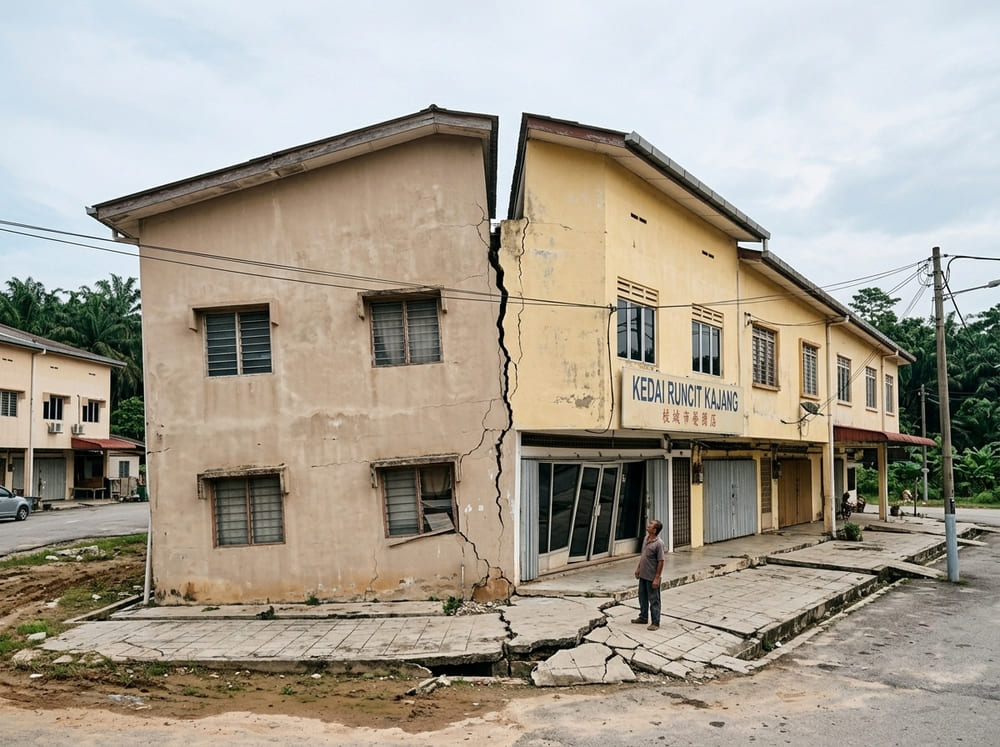
- Differential settlement is uneven settlement where one part of a building sinks more than another.
- It is the primary cause of diagonal wall cracks, door/window misalignment, floor unevenness and structural distress in buildings.
- In Malaysia, high-risk scenarios include sites with variable ground conditions, coastal soft clay, peat, limestone terrain, ex-mining land and cut-fill transition zones.
- Acceptable differential settlement limits are typically 1/500 of the span for conventional buildings, but vary depending on structure type and sensitivity.
- The most effective prevention is comprehensive soil investigation across the entire building footprint, followed by consistent foundation design matched to actual ground conditions.
What Is Differential Settlement?
Differential settlement is the uneven downward movement of a building’s foundation, where one area settles more than another. While some degree of total settlement is expected in any structure, it is the difference in settlement between two points that causes structural damage.
When the left side of a building settles 30 mm and the right side settles 5 mm, the 25 mm difference creates angular distortion in the structure. This distortion generates internal stresses — bending, shear and tension — that manifest as cracks in walls, distorted openings, uneven floors and, in severe cases, structural failure.
Differential settlement is often described as a “hidden risk” because it develops gradually. By the time visible cracks appear, significant ground movement has already occurred. Early detection through monitoring and prevention through proper geotechnical investigation are far more effective than after-the-fact repairs.
Differential Settlement vs Uniform Settlement
| Parameter | Uniform Settlement | Differential Settlement |
|---|---|---|
| Definition | Entire building settles by the same amount | Different parts of the building settle by different amounts |
| Structural impact | Generally low — no internal distortion | High — creates bending, shear and tensile forces |
| Visible damage | Minimal cracking; serviceability issues (utility connections, access levels) | Diagonal cracks, distorted openings, uneven floors, separation of elements |
| Common causes | Uniformly compressible ground, evenly distributed loading | Variable ground conditions, uneven loading, mixed foundations |
| Risk level | Low to moderate | Moderate to critical |
| Key concern | Building level relative to surroundings | Internal structural integrity |
In practice, truly uniform settlement is rare. Most settlement problems involve some degree of differential movement.
Why Differential Settlement Happens
Variable Soil Conditions Across the Site
This is the most common cause. A building footprint may span different soil types — firm residual soil on one side and soft clay or peat on the other. Without adequate borehole coverage across the full site, these variations can go undetected until construction reveals them.
In Malaysia, ground variability is particularly pronounced on ex-mining land (random pockets of fill and tailings), cut-fill platforms (firm cut ground next to compressible fill), and sites near geological boundaries.
Uneven Structural Loading
Buildings with significantly different loading intensities — such as a tower block connected to a low-rise podium, or a heavy lift shaft adjacent to a lightly loaded area — will impose different stresses on the ground. If the foundation design does not account for these load differences, differential settlement results.
Mixed Foundation Types
Using different foundation systems within the same structure — for example, piled foundations for the main building and shallow footings for an attached canopy or entrance — creates a mismatch in settlement behaviour. Piled foundations settle minimally, while shallow foundations on compressible soil settle significantly, causing a step at the junction.
Changes in Groundwater
Localised lowering of the groundwater table — from dewatering on an adjacent site, seasonal fluctuation, or drainage changes — increases effective stress on the soil in the affected area, triggering consolidation settlement. If the drawdown is localised, settlement is also localised, creating differential movement.
Adjacent Construction Activity
Excavation, piling or surcharge loading on a neighbouring site can cause ground movement beneath existing buildings. The effect is typically more pronounced on the side closest to the adjacent activity, producing differential settlement.
Inadequate Soil Investigation
Insufficient borehole coverage — too few boreholes, too shallow, or concentrated in only part of the site — leaves data gaps. Ground conditions between boreholes are interpolated, and if the actual ground is softer or more variable than assumed, differential settlement can result.
Who Is Affected by Differential Settlement?
- Property owners & occupants — cracking, door/window problems and floor unevenness affect daily use and property value.
- Developers — defect liability claims and remediation costs during and after the defect liability period.
- Structural engineers — design responsibility for foundation adequacy and structural tolerance to settlement.
- Contractors — construction claims related to ground conditions differing from investigation data.
- Facility managers — ongoing maintenance burden for buildings affected by progressive settlement.
- Owners of adjacent buildings — settlement induced by nearby construction activity.
How Differential Settlement Damages Buildings
Structural Cracking Patterns
Differential settlement produces characteristic crack patterns. Diagonal cracks radiating from window and door corners are the most common indicator — the cracks propagate in the direction of the greater settlement. Stepped cracks following mortar joints in brickwork are another telltale sign.
Door & Window Distortion
As the structure distorts, door and window frames go out of square. Doors stick, windows do not close properly, and gaps appear at the top or bottom of openings. This is often the earliest noticeable sign.
Floor & Slab Movement
Ground-supported floor slabs can crack, tilt or develop steps at construction joints. In severe cases, the floor slopes noticeably — a marble placed on the floor rolls to one side.
Utility & Service Disruption
Underground pipes, drains and utility connections are rigid. Differential settlement can shear pipe connections, block drainage falls and damage buried services, leading to leaks, blockages and functional failures.
Aesthetic & Property Value Impact
Even where structural safety is not compromised, visible cracking, uneven floors and distorted features reduce property value and market appeal. Buyers and tenants are understandably wary of buildings showing settlement damage.
Warning Signs of Differential Settlement

| Sign | Description | Action Required |
|---|---|---|
| Diagonal cracks from window/door corners | Cracks propagating toward the area of greater settlement | Professional structural assessment |
| Stepped cracks in brickwork | Cracks following mortar joints in a staircase pattern | Geotechnical & structural assessment |
| Doors/windows sticking | Frames distorted by structural movement | Monitor and investigate if worsening |
| Uneven floors | Floor slopes in one direction or has steps at joints | Level survey to quantify movement |
| Gap between wall and ceiling | Structural elements separating due to rotation | Structural assessment — potentially serious |
| Cracking at building junctions | Cracks where extensions, podiums or different structures meet | Investigate foundation type transition |
| External paving separating from building | Relative movement between building and ground | Monitor — indicates ongoing settlement |
| Bulging or bowing walls | Walls being pushed or pulled by differential movement | Urgent structural assessment |
How Differential Settlement Is Measured & Assessed
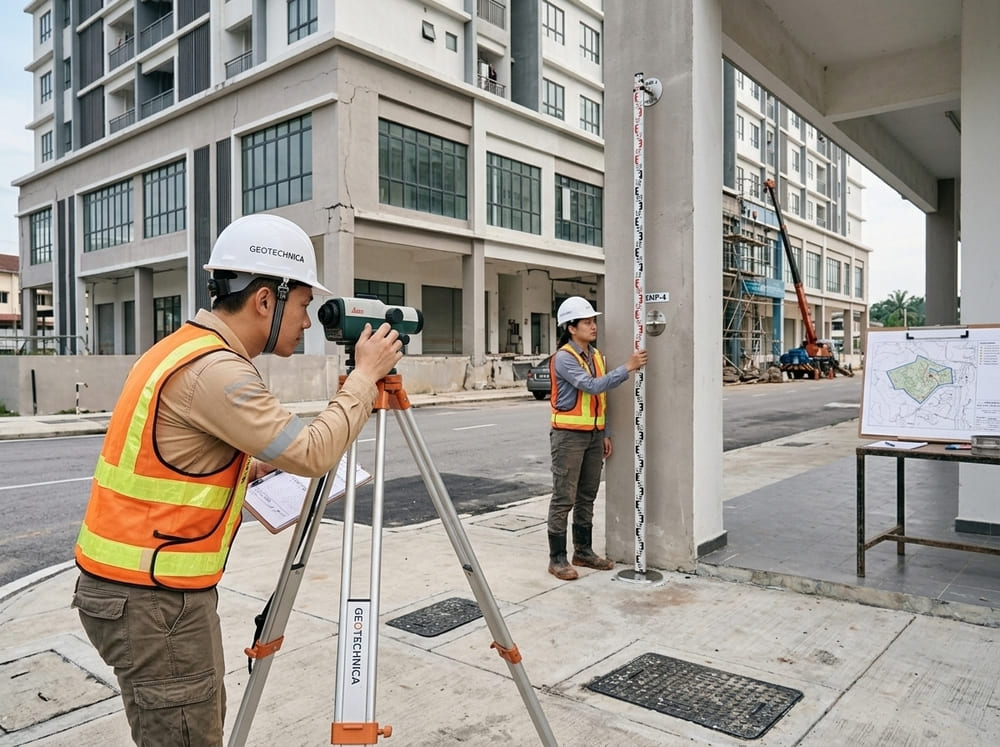
Precise Level Survey
The most direct measurement method. Survey markers (reference points) are installed at multiple locations on the building — columns, corners, load-bearing walls — and precise levelling surveys are conducted at regular intervals (weekly, monthly or quarterly depending on settlement rate). The difference in level between any two points gives the differential settlement.
Crack Monitoring
Crack gauges (tell-tales) are installed across active cracks to measure whether they are widening, closing or stable. Demec gauges or crack callipers provide precise measurements. Monitoring over time distinguishes active settlement from historical movement.
Inclinometer & Tiltmeter Monitoring
Inclinometers installed in boreholes adjacent to the building measure lateral ground movement. Tiltmeters mounted on the structure measure angular rotation. These instruments are particularly useful for monitoring buildings near excavation or piling works.
Geotechnical Investigation
If differential settlement is suspected, boreholes may be drilled adjacent to or through the building’s foundation to assess the ground conditions causing the problem. This helps determine whether the settlement is likely to continue and what remediation is appropriate.
Malaysia-Specific Differential Settlement Risks
Coastal Soft Clay
Malaysia’s west coast is underlain by marine clay deposits that vary in thickness. A building footprint that spans areas of different clay thickness will experience differential consolidation settlement. Port Klang, Penang and parts of Johor Bahru are particularly susceptible.
Peat Soil
Peat thickness can vary dramatically over short distances — from 2 m to 10 m within the same site. This natural variability makes differential settlement on peat almost inevitable without ground treatment. Peat areas in Sarawak, Johor and Selangor require particularly careful investigation.
Limestone / Karst Terrain
Limestone bedrock surfaces are characteristically irregular — pinnacles rising 10–20 m above troughs within metres of horizontal distance. Foundations resting on pinnacles have virtually zero settlement, while those spanning troughs over soft infill material can settle substantially. This creates extreme differential settlement scenarios.
Ex-Mining Land
Former tin mining areas contain randomly distributed pockets of loose sand, clay, gravel and voids. The ground profile is inherently unpredictable and non-uniform, making differential settlement a primary design concern.
Transition Zones (Cut-Fill Boundaries)
On hillside developments and platform sites, the boundary between cut ground (firm, undisturbed) and fill ground (compressible, placed) creates a natural differential settlement risk. If the transition is not identified and managed in the foundation design, cracking occurs at or near the cut-fill boundary.
Tolerable Differential Settlement Limits
The following table shows commonly referenced limits. These are general guidelines — project-specific limits should be determined by the structural and geotechnical engineer.
| Structure Type | Maximum Angular Distortion (δ/L) | Approximate Differential Settlement for 6 m Span |
|---|---|---|
| Reinforced concrete frame buildings | 1/500 | 12 mm |
| Load-bearing masonry walls | 1/1000 to 1/700 | 6–9 mm |
| Steel frame buildings (flexible) | 1/300 | 20 mm |
| Industrial buildings (crane rails) | 1/1000 | 6 mm |
| Sensitive finishes (tiling, glass facades) | 1/1000 | 6 mm |
| Machinery foundations (vibration-sensitive) | 1/2000 | 3 mm |
Source: General references from Eurocode 7, BS 8004, and Skempton & MacDonald (1956). Actual tolerable limits depend on specific structural details and should be confirmed by the project engineer.
How To Prevent Differential Settlement
1. Comprehensive soil investigation across the full building footprint — not just a few boreholes in one area. Ensure boreholes are positioned at building corners, heavily loaded zones and areas suspected of variable ground.
2. Consistent foundation type — avoid mixing piled and unpiled foundations within the same structure wherever possible. If different systems are necessary, design for the expected differential movement at the junction.
3. Adequate borehole spacing in variable ground — in karst, ex-mining or transition zones, closer borehole spacing is essential to map the actual ground variability.
4. Ground improvement where needed — preloading with surcharge, vertical drains (PVD), stone columns or cement stabilisation can reduce and equalise settlement across the site.
5. Structural design for tolerance — incorporate movement joints, flexible connections and structural detailing that accommodates a defined amount of differential settlement.
6. Settlement monitoring programme — install monitoring points before construction begins and track settlement throughout construction and the post-construction period.
7. Pre-condition survey for adjacent buildings — document the condition of neighbouring buildings before starting construction to establish a baseline for any future settlement claims.
Remediation Options for Differential Settlement
When differential settlement has already occurred, remediation options include:
- Underpinning — extending foundations to deeper bearing strata to arrest further settlement.
- Micropiling — installing small-diameter piles through existing foundations to transfer loads to competent ground.
- Compaction grouting — injecting grout to lift and stabilise settled areas.
- Structural jacking — carefully raising the settled portion of the structure using hydraulic jacks.
- Structural strengthening — adding reinforcement, tie bars or crack stitching to restore structural integrity.
- Movement joints — retrofitting joints to allow controlled movement rather than uncontrolled cracking.
- Drainage management — controlling groundwater to prevent further consolidation-driven settlement.
The appropriate remediation method depends on the cause, magnitude and rate of settlement, the structural condition of the building, and cost-benefit considerations. A geotechnical and structural assessment is essential before selecting a remediation strategy.
Common Mistakes That Lead to Differential Settlement
1. Concentrating boreholes in one area of the site — ground conditions 30 m away could be completely different.
2. Designing foundations based on assumed ground uniformity — without verifying it through adequate investigation.
3. Mixing foundation types at structural junctions — piled core with shallow-founded extensions is a classic setup for differential settlement.
4. Ignoring cut-fill boundaries — on platform sites, the cut-fill transition must be identified and the foundation designed to bridge it.
5. Not accounting for adjacent construction — failing to assess and mitigate the impact of nearby excavation, dewatering or piling on existing structures.
6. Treating cracks as cosmetic issues — repainting or plastering over cracks without investigating the cause allows the problem to worsen.
Practical Checklist — Reducing Differential Settlement Risk
- Soil investigation covers the entire building footprint — not just selected zones
- Borehole spacing is adequate for the expected ground variability (closer in karst, ex-mining, cut-fill areas)
- Ground conditions are confirmed as reasonably uniform, or design accounts for variability
- Foundation type is consistent across the structure (or junctions are designed for differential movement)
- Consolidation settlement has been calculated and compared against tolerable limits
- Ground improvement has been considered where compressible layers exist
- Movement joints are specified at appropriate locations (e.g., cut-fill boundaries, different loading zones)
- Settlement monitoring plan is in place for construction and post-construction
- Pre-condition survey of adjacent buildings has been completed
- Structural design team has reviewed and accepted the geotechnical settlement predictions
FAQ
1. What is differential settlement?
Differential settlement is the uneven settlement of a building’s foundation, where one part sinks more than another. This uneven movement creates internal stresses in the structure, leading to diagonal cracking, distorted door and window frames, uneven floors and potential structural damage. It is more damaging than uniform settlement because the structure is forced to deform.
2. What is the difference between differential settlement and total settlement?
Total settlement is the overall downward movement of a foundation point from its original level. Differential settlement is the difference in total settlement between two points. A building can have large total settlement with zero differential settlement (if it sinks evenly) — this is generally harmless. Conversely, small total settlement with significant differential settlement can cause serious structural damage.
3. Can differential settlement be repaired?
Yes, but it is significantly more expensive than prevention. Remediation methods include underpinning, micropiling, grouting and structural jacking. The key is to first identify and address the cause of the differential settlement before repairing the structural damage. Simply filling cracks without addressing the ground problem results in repeated damage.
4. How do I know if my building has differential settlement?
Common indicators include diagonal cracks at window and door corners, doors and windows that stick or will not close, uneven floors, gaps between walls and ceiling, and visible tilting. A precise level survey by a qualified surveyor can confirm and quantify differential settlement. Monitoring over time distinguishes active ongoing movement from historical settlement.
5. Is differential settlement always caused by poor ground conditions?
No. While variable ground conditions are the most common cause, differential settlement can also result from uneven structural loading, mixed foundation types, groundwater changes, adjacent construction activity and overloading. Even on uniform ground, poor foundation design or construction practices can trigger differential movement.
Why Choose Geotechnica?
Geotechnica Sdn Bhd specialises in identifying and mitigating differential settlement risks across Malaysia’s diverse and challenging ground conditions.
- Comprehensive site investigation — adequate borehole coverage to capture ground variability across your entire site, not just a few points.
- Settlement prediction & analysis — geotechnical modelling to predict both total and differential settlement before construction, allowing design adjustments early.
- Specialised experience in high-risk ground — peat, soft clay, limestone karst, ex-mining land and coastal reclamation — the ground conditions most associated with differential settlement in Malaysia.
- Monitoring services — settlement monitoring during and after construction using precise survey methods.
- Professional leadership — led by P.Geol. Gs. Hairil Azwan Razak, with 15 years of experience in geotechnical engineering and geohazard assessment across Malaysia.
Conclusion
Differential settlement is one of the most common — and most preventable — causes of building damage in Malaysia. The characteristic diagonal cracks, distorted frames and uneven floors that affect thousands of buildings across the country are almost always traceable back to inadequate understanding of ground conditions or foundation design that did not account for ground variability.
The solution is not complex: investigate the ground thoroughly across the full building footprint, design foundations consistently based on actual data, treat or improve the ground where it is weak, and monitor settlement during and after construction. These steps cost a fraction of what remediation costs — and they protect not just the structure, but the people and investments inside it.
SOURCES / REFERENCES
- BS 8004:2015 — Code of Practice for Foundations
- BS EN 1997 (Eurocode 7) — Geotechnical Design
- Skempton, A.W. & MacDonald, D.H. (1956) — Allowable Settlement of Buildings
- Burland, J.B. & Wroth, C.P. (1974) — Settlement of Buildings and Associated Damage
- BS 5930:2015+A1:2020 — Code of Practice for Ground Investigations
- JKR Malaysia — Foundation Design Guidelines
- Jabatan Mineral dan Geosains Malaysia (JMG) — Geological Survey Data
- Geotechnica Sdn. Bhd. — internal project experience and technical references
This article has been technically reviewed by P.Geol. Gs. Hairil Azwan, Geohazard Specialist and Managing Director at Geotechnica Sdn. Bhd., with 15 years of professional experience in geology, geotechnical engineering and geospatial technology.
Next Review: 10 February 2027


