

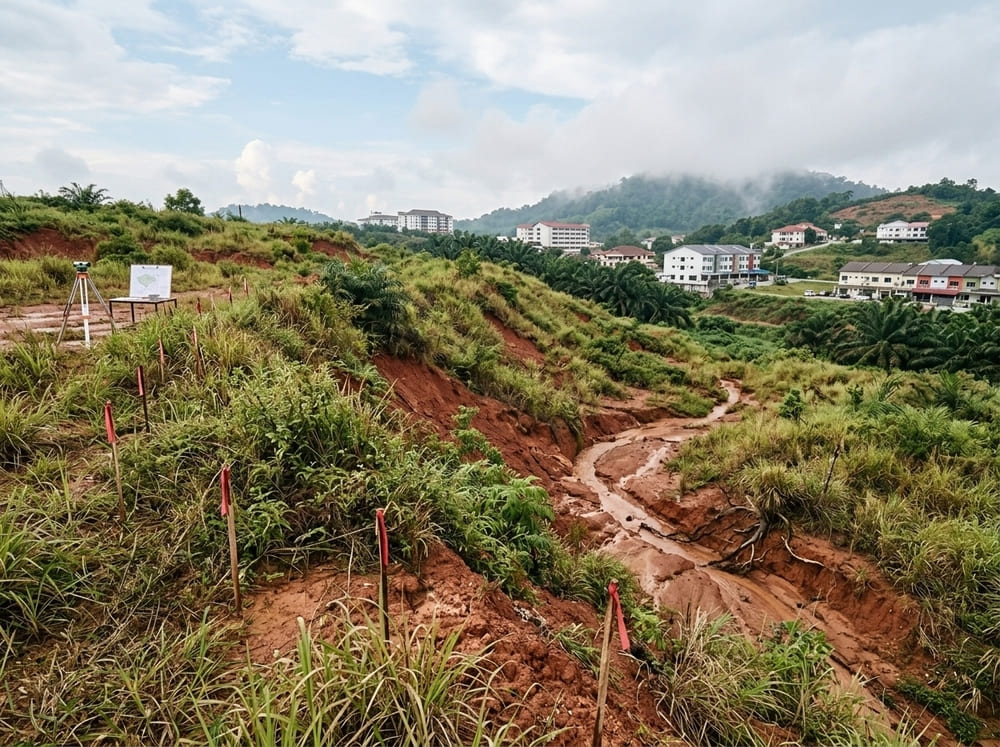
- Soil investigation is not just a regulatory formality — it is a risk management necessity for any construction project.
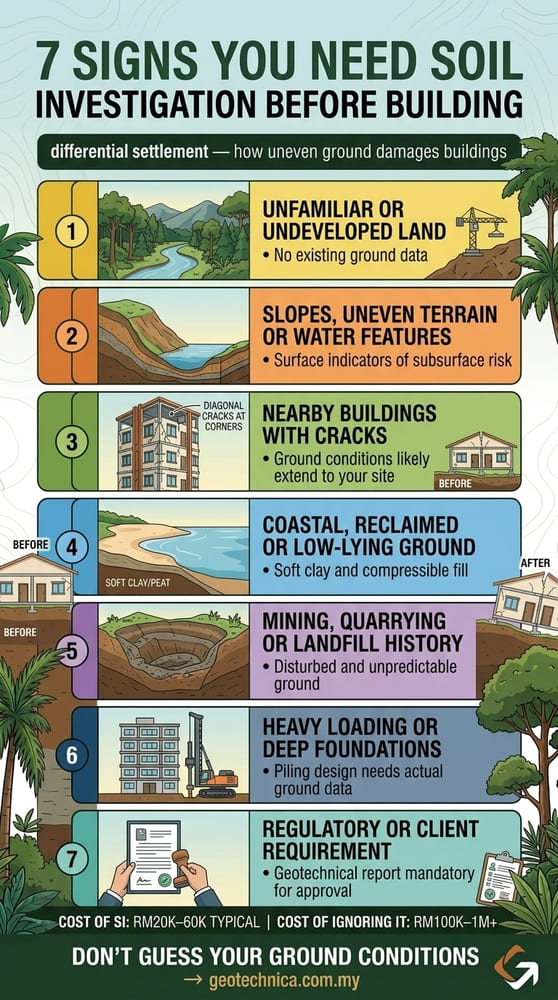
- Seven key warning signs indicate your project needs soil investigation before design or construction begins.
- These signs include unfamiliar land, sloped or uneven terrain, settlement damage in neighbouring buildings, coastal or low-lying ground, former mining or landfill history, heavy structural loading and regulatory requirements.
- In Malaysia, ground conditions such as peat, soft clay, limestone and ex-mining land make soil investigation especially critical.
- The cost of skipping soil investigation almost always exceeds the cost of conducting one — often by 10 to 50 times when problems surface during construction.
What Is Soil Investigation?
Soil investigation — also called site investigation or geotechnical investigation — is the process of examining subsurface ground conditions through borehole drilling, sampling, field testing and laboratory analysis. The purpose is to determine what the ground is made of, how strong it is, where groundwater sits, and whether any geological hazards exist that could affect the proposed construction.
The output is a geotechnical report containing borehole logs, Standard Penetration Test (SPT) data, laboratory results, soil stratigraphy and foundation design recommendations. This report is the basis for every structural and geotechnical engineering decision on the project.
For a detailed breakdown of the process, refer to our guide on the site investigation process.
Why Some Projects Skip Soil Investigation — And Why It Backfires
Despite its importance, soil investigation is sometimes omitted or under-scoped. The reasons are predictable:
- “We want to save cost.” — Soil investigation is seen as an expense rather than an investment. The irony is that skipping it is one of the most expensive decisions a project owner can make.
- “The neighbour’s site was fine.” — Ground conditions can change dramatically over short distances. What applies 50 m away may not apply to your site.
- “We’ve built on similar ground before.” — Past experience on different sites does not substitute for site-specific data. Every site is unique.
- “We’ll deal with it during construction.” — Reactive problem-solving during construction is always more expensive, slower and riskier than proactive investigation.
The consequences of skipping soil investigation are well-documented: foundation redesign mid-project, piling cost overruns from unexpected ground, construction delays, structural settlement, regulatory rejection and — in worst cases — building failure.
7 Signs You Need Soil Investigation For Your Project
Sign 1 — You Are Building on Unfamiliar or Undeveloped Land
If you have no existing geotechnical data for the site — no previous soil investigation report, no borehole records from adjacent developments, no reliable information about what lies beneath the surface — you need soil investigation.
Undeveloped land, agricultural land, former plantation sites and greenfield parcels are particularly risky because there is no construction track record to reference. The ground could be anything: firm residual soil, soft clay, peat, fill material or weathered rock. Without boreholes, you are guessing.
Action: Commission a soil investigation before proceeding beyond conceptual design.
Sign 2 — The Site Has Visible Slope, Uneven Terrain or Water Features
Sloped terrain, undulating ground, natural drainage channels, ponds, marshy patches or springs are all surface indicators of potential subsurface challenges. Slopes suggest potential stability issues. Water features indicate high water tables, soft ground or drainage problems. Uneven terrain may reflect variable ground conditions beneath.
In Malaysia, hillside developments on slopes steeper than 15° require mandatory geotechnical investigation under JKR guidelines. Even gentler slopes warrant investigation if the proposed building involves any earthworks or retaining structures.
Action: Conduct soil investigation with additional geophysical surveys (electrical resistivity, MASW) for slope and groundwater assessment.
Sign 3 — Nearby Buildings Show Cracks or Settlement Damage
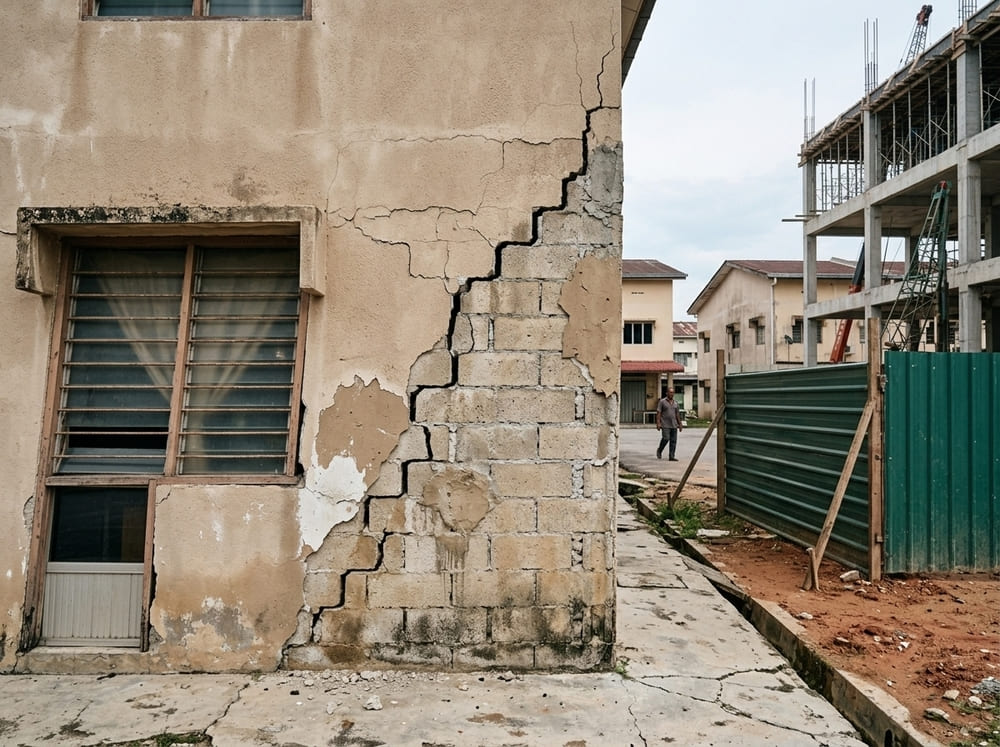
If adjacent buildings display diagonal wall cracks, uneven floors, tilting, or visible foundation distress, these are strong indicators that the local ground conditions are problematic. Settlement damage in neighbouring structures suggests compressible soils, variable ground or groundwater issues that will likely affect your site too.
Do not assume that your building will be different — the same ground conditions extend beneath your site. If anything, the neighbour’s problems provide free warning that your project needs careful geotechnical assessment.
Action: Investigate the ground conditions thoroughly and review any available geotechnical data from adjacent developments.
Sign 4 — The Site Is on Coastal, Reclaimed or Low-Lying Ground
Coastal areas, reclaimed land and low-lying floodplains in Malaysia are typically underlain by soft marine clay, loose fill or organic soils. These materials are highly compressible, have low bearing capacity and are prone to long-term consolidation settlement.
High-profile examples across Malaysia — Port Klang, Penang reclamation areas, Johor’s Forest City, Melaka waterfront — all involve ground that demands comprehensive geotechnical investigation before construction.
Even seemingly firm reclaimed land can conceal layers of soft clay beneath the placed fill that will compress under building loads over months and years.
Action: Soil investigation must assess both the fill layer and the underlying natural ground. Consolidation testing is essential.
Sign 5 — The Area Has a History of Mining, Quarrying or Landfill
Former tin mining land (common in Perak, Selangor, Pahang), old quarry sites and areas used for waste disposal contain highly disturbed, unpredictable ground. Mining land may have loose tailings, old shafts, ponds, buried debris and random fill. Quarry sites may have unstable rock faces and irregular backfill. Landfill sites contain decomposing waste, gas pockets and contaminated soil.
These sites are developable, but only with thorough investigation to map the disturbed ground profile and identify hazards.
Action: Closer borehole spacing than normal, supplemented with geophysical surveys to detect voids and ground variability.
Sign 6 — Your Project Involves Heavy Structural Loading or Deep Foundations
Projects with significant structural loads — high-rise buildings, data centres, industrial warehouses with heavy equipment, bridges, tanks and silos — impose high stresses on the ground. The foundation design for these structures is directly dependent on accurate ground data.
Similarly, projects that require deep foundations (bored piles, driven piles, micropiles) need borehole data to determine pile lengths, founding strata and expected pile capacity. Piling without soil investigation data is a gamble.
Action: Soil investigation with boreholes drilled to at least 5 m below the anticipated pile toe level, with appropriate laboratory testing for foundation design parameters.
Sign 7 — Local Authority or Client Requires a Geotechnical Report
In Malaysia, most local authorities (Pihak Berkuasa Tempatan — PBT) require a soil investigation report as part of the development order (Kebenaran Merancang) submission. For hillside developments, JKR mandates comprehensive geotechnical reports. Many private clients, particularly government-linked companies and international developers, also require geotechnical reports as standard procurement practice.
If your project approval depends on a geotechnical report, soil investigation is not optional — it is a submission requirement. Starting the investigation early prevents delays to the approval timeline.
Action: Confirm submission requirements with the relevant local authority or client before design proceeds.
Quick Self-Assessment: Does Your Project Need Soil Investigation?
Use this decision table to assess whether your project needs soil investigation. If you answer “Yes” to any row, soil investigation is recommended.
| Question | Yes | No |
|---|---|---|
| Is this a new site with no previous geotechnical data? | SI needed | Review existing data first |
| Does the site have slopes, uneven terrain or water features? | SI needed | Lower risk, but SI still recommended |
| Do nearby buildings show cracks, settlement or foundation damage? | SI needed | Lower risk indicator |
| Is the site on coastal, reclaimed or low-lying ground? | SI needed | — |
| Does the area have mining, quarrying or landfill history? | SI needed | — |
| Will the project involve heavy loading or deep foundations (piling)? | SI needed | SI still recommended for shallow foundations |
| Does the local authority or client require a geotechnical report? | SI mandatory | Confirm with PBT — most require it |
| Is the project value above RM500,000? | SI strongly recommended | Assess risk vs project value |
If you answered “Yes” to even one question, soil investigation is the prudent course of action. For most construction projects in Malaysia, the answer to multiple questions is “Yes.”
Who Needs to Act on These Signs?
Recognising the signs is only useful if the right people take action at the right time:
- Developers & project owners — you commission and pay for soil investigation. Act during the feasibility or land acquisition phase, not after design has started.
- Consulting engineers — you advise the client on whether soil investigation is needed and specify the scope. Your professional duty of care includes recommending adequate investigation.
- Architects — you are often the first professional engaged. If you see any of these signs during site visits, flag the need for geotechnical input to the client.
- Contractors — if you are tendering a project and no soil investigation report exists, raise it. Pricing earthworks and piling without ground data exposes you to significant commercial risk.
- Land buyers & investors — before purchasing land for development, check whether existing geotechnical data is available. The cost of soil investigation before purchase is negligible compared to the risk of buying land with hidden ground problems.
What Happens When You Ignore These Signs
The consequences of proceeding without soil investigation are consistently more expensive than the investigation itself:
Foundation redesign during construction — When unexpected ground conditions are discovered after piling or earthworks have started, the foundation design must be revised. This causes delays, re-mobilisation costs and potential contractual disputes.
Piling cost overruns — Without soil investigation data, pile lengths are estimated. If piles need to be significantly longer than assumed, the additional piling cost can run into hundreds of thousands of ringgit on a medium-sized project.
Construction delays — Ground-related surprises are among the most time-consuming problems to resolve on site. Re-investigation, design revision and remedial works can add weeks or months to the programme.
Structural settlement & cracking — Foundations designed on assumed rather than actual ground data are at risk of settlement. Remedial works for settlement damage are far more expensive than preventive soil investigation.
Regulatory rejection — Submitting a development plan without the required geotechnical report results in rejection and re-submission delays. In some cases, approvals already granted can be revoked if ground-related incidents occur.
Legal liability — If a building fails or suffers damage due to ground conditions that should have been investigated, the developer, engineer and contractor all face potential professional liability claims.
Malaysia-Specific Ground Risks That Demand Investigation
Peat Soil Zones
Peat is found across Sarawak (especially coastal areas), Johor (Pontian, Batu Pahat) and parts of Selangor. Peat is extremely compressible — it can lose 20–40% of its thickness under loading. Buildings on peat without proper ground treatment or piled foundations will experience severe settlement.
Soft Marine Clay
Prevalent along Malaysia’s west coast, particularly in Port Klang, Penang, Johor Bahru and Melaka. Marine clay has very low bearing capacity and undergoes long-term consolidation settlement. Structures on marine clay require careful foundation design, often with piled foundations and ground improvement.
Limestone & Karst
Found in Ipoh, Batu Caves, Perlis, Langkawi and parts of Sabah. Limestone terrain conceals cavities, sinkholes and highly irregular rock surfaces. Construction on karst without thorough investigation — including geophysical surveys — risks sudden ground collapse and extreme differential settlement.
Ex-Mining Land
Former tin mining areas in Perak, Selangor and Pahang present unpredictable ground conditions. Loose tailings, old pits, random fill and buried debris create a subsurface profile that varies dramatically over short distances. Closer borehole spacing is essential.
Hillside & Slope Developments
Malaysia has experienced multiple slope failures with tragic consequences. JKR guidelines require comprehensive geotechnical investigation for all hillside developments. Slope stability analysis, groundwater assessment and long-term monitoring are typically mandated.
What Does a Soil Investigation Involve?
For readers unfamiliar with the process, a typical soil investigation includes:
- Desktop study — reviewing geological maps, historical records and previous investigation data.
- Site reconnaissance — a physical walkover to observe terrain, drainage, vegetation and access conditions.
- Borehole drilling — drilling holes to predetermined depths, collecting soil/rock samples at 1.5 m intervals and performing the Standard Penetration Test (SPT).
- In-situ testing — additional field tests such as vane shear, CPT or Mackintosh probe depending on ground conditions.
- Laboratory testing — classification, strength, compressibility and chemical tests on collected samples.
- Reporting — a geotechnical report with borehole logs, test results, soil stratigraphy and foundation recommendations.
For the full step-by-step breakdown, see our detailed guide on the site investigation process.
Cost of Soil Investigation vs Cost of Ignoring It
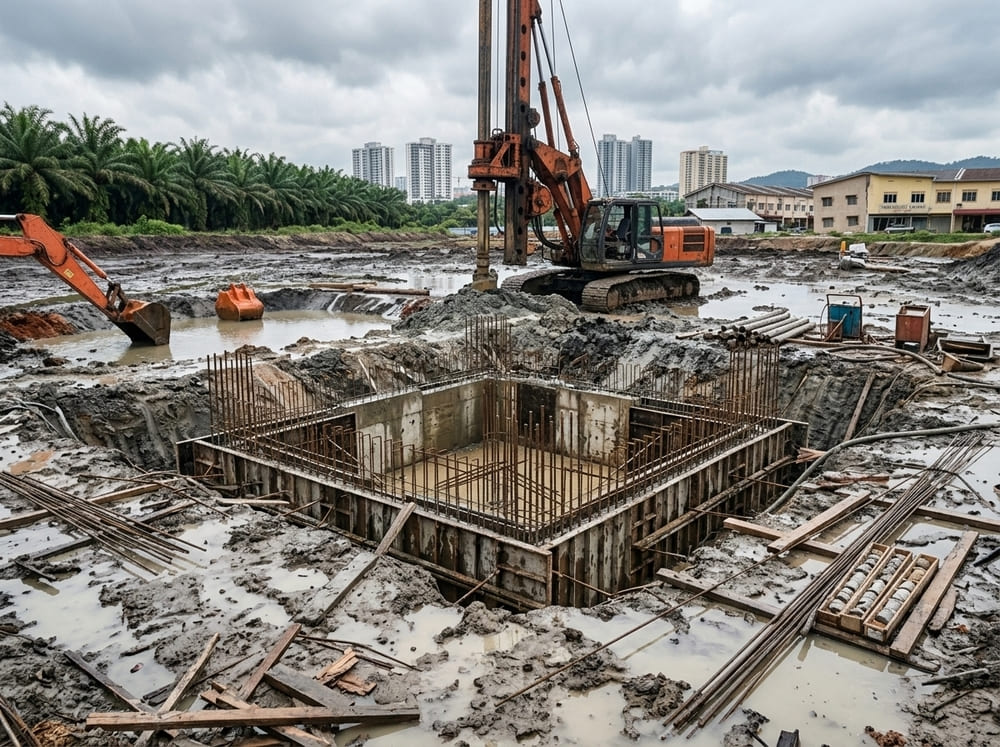
The following comparison illustrates why soil investigation is an investment, not an expense:
| Scenario | Estimated Cost |
|---|---|
| Soil investigation for a typical residential development (5–10 boreholes) | RM20,000 – RM60,000 |
| Piling cost overrun due to unexpected soft ground (additional pile length × number of piles) | RM100,000 – RM500,000+ |
| Foundation redesign mid-construction (engineering, re-mobilisation, delays) | RM50,000 – RM300,000+ |
| Structural remediation for settlement damage (underpinning, grouting, repair) | RM200,000 – RM1,000,000+ |
| Project delay cost (extended preliminaries, financing, opportunity cost) | Variable — often RM50,000 – RM200,000+ per month |
These are indicative ranges to illustrate relative magnitude. Actual costs depend on project specifics. The point is clear: the cost of soil investigation is always a fraction of the cost of the problems it prevents.
For detailed cost information, refer to our guide on soil investigation cost in Malaysia.
Practical Checklist — Before You Decide to Skip Soil Investigation
If you are considering proceeding without soil investigation, answer these questions honestly:
- Do you have reliable geotechnical data for the exact site (not just nearby)?
- Are you confident the ground is uniform across the entire building footprint?
- Is the site free from slope, water features, mining history or reclamation?
- Are nearby buildings free from cracks, settlement or foundation issues?
- Does the local authority not require a geotechnical report for your project type?
- Is your structural engineer comfortable designing foundations without ground data?
- Are you prepared to accept the commercial risk of ground-related surprises during construction?
If you answered “No” to any of these, you need soil investigation.
FAQ
1. How do I know if my project needs soil investigation?
If your project involves any construction that places load on the ground — buildings, roads, embankments, retaining walls, tanks — soil investigation is recommended. It is especially critical if the site is on unfamiliar land, slopes, coastal ground, ex-mining areas, or if nearby buildings show settlement damage. In Malaysia, most local authorities require a geotechnical report for development plan approval.
2. Can I use soil investigation data from a neighbouring site?
Neighbouring site data can provide useful preliminary information, but it should not replace site-specific investigation. Ground conditions in Malaysia can vary significantly over short distances, particularly in karst terrain, ex-mining areas and transition zones. Your foundation design should always be based on data from boreholes drilled within your own site boundaries.
3. Is soil investigation required for small residential projects?
While regulatory requirements vary by local authority, soil investigation is recommended even for small projects such as individual bungalows or semi-detached houses — especially on sloped land, soft ground, reclaimed land or areas with known geological complexity. The cost of a basic soil investigation (1–3 boreholes) is modest compared to the risk of foundation problems.
4. What happens if I build without soil investigation?
You may encounter unexpected ground conditions during construction — soft clay, rock, voids, high water table — that require foundation redesign, additional piling, ground treatment or other remedial works. These unplanned costs typically exceed the cost of soil investigation by 10 to 50 times. In severe cases, buildings can experience settlement, cracking and structural distress that require expensive long-term remediation.
5. When is the best time to do soil investigation?
The ideal time is during the feasibility or preliminary design phase — before detailed structural design begins. This allows the geotechnical data to inform foundation design, earthwork planning and project costing from the start. Soil investigation can also be conducted before land purchase to assess development viability and identify potential hidden costs.
Why Choose Geotechnica?
Geotechnica Sdn Bhd helps project owners, engineers and developers across Malaysia make confident ground decisions — starting with recognising when soil investigation is needed and delivering the data to act on.
- Honest scoping — Geotechnica recommends investigation scope based on your actual project needs and site conditions, not a generic package. If you do not need extensive investigation, they will tell you.
- Full-service capability — from desktop study and borehole drilling to laboratory testing, geophysical surveys and geotechnical reporting under one team.
- Malaysia-wide experience — projects across Peninsular Malaysia, Sabah and Sarawak covering every ground condition type: peat, soft clay, limestone karst, ex-mining land, hillside terrain and reclaimed ground.
- Technology-integrated approach — borehole testing combined with electrical resistivity, MASW and LiDAR mapping for comprehensive site assessment where needed.
- Professional leadership — led by P.Geol. Gs. Hairil Azwan Razak, Geohazard Specialist with 15 years of geotechnical engineering experience.
Conclusion
The seven signs outlined in this article are not theoretical — they are patterns observed repeatedly across construction projects in Malaysia. Every sign points to the same conclusion: when there is any doubt about ground conditions, soil investigation is the answer.
The cost of a properly scoped soil investigation is always a fraction of the cost of the problems it prevents. Foundation redesign, piling overruns, construction delays, settlement damage and regulatory rejection all cost more — in money, time and reputation — than investing in ground data upfront.
If you recognise even one of these signs in your project, the next step is clear: engage a qualified geotechnical consultant and investigate the ground before you build on it.
SOURCES / REFERENCES
- BS 5930:2015+A1:2020 — Code of Practice for Ground Investigations
- BS EN 1997 (Eurocode 7) — Geotechnical Design
- Jabatan Kerja Raya (JKR) — Guidelines for Slope Design and Geotechnical Investigation
- Jabatan Mineral dan Geosains Malaysia (JMG) — Geological Hazard Mapping
- Garis Panduan Pembangunan di Kawasan Tanah Tinggi — Highland Development Guidelines
- Institution of Engineers Malaysia (IEM) — Geotechnical Engineering Division
- Geotechnica Sdn. Bhd. — internal project experience and technical references
This article has been technically reviewed by P.Geol. Gs. Hairil Azwan, Geohazard Specialist and Managing Director at Geotechnica Sdn. Bhd., with 15 years of professional experience in geology, geotechnical engineering and geospatial technology.
Next Review: 10 February 2027


